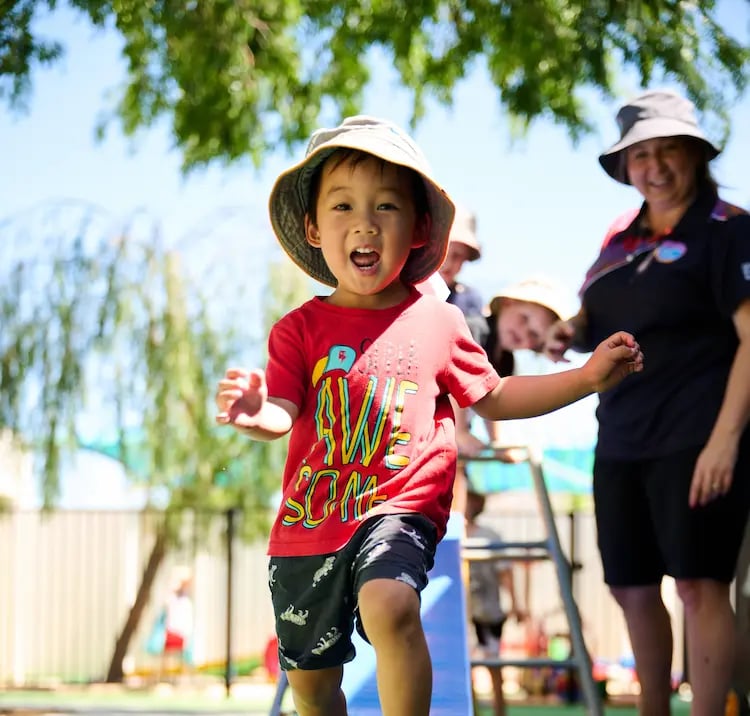
Play Active program for early childhood education and care
Play Active is a national program supporting early childhood education and care (ECEC) services to create healthy and active environments for young children. Co-developed with educators, researchers, health agencies, and play experts, the program provides evidence-based policy guidance on recommended levels of children’s physical activity and sedentary time in ECEC. Policy implementation strategies include 25 evidence-based practices, professional development, resources, and practical tools to boost children’s daily energetic play in ECEC. By supporting educators and families, Play Active aims to build healthy habits early, improving early movement behaviours, development, and mental health across the life course.
Background and rationale
Active play is essential for healthy development. Yet less than one in ten children in Australia aged 3–5 years meet the Australian 24-hour Movement Guidelines for the Early Years energetic play recommendations.1 The impacts of physical inactivity in the early years are long-lasting as physical activity behaviours established in childhood can track into later life.
The World Health Organization recommends ECEC as a key setting for physical activity promotion, with approximately one million Australia children attending ECEC services.2 Australian National Quality Standard for ECEC state that “each child’s health and physical activity is supported and promoted”,3 but there is little guidance for educators on how to practically support and promote children’s physical activity including how much physical activity children need while in care. Play Active was developed to address this gap.
Overview
To create meaningful, stakeholder-informed change, Play Active’s partners include the ECEC sector (Early Childhood Australia, Australian Childcare Alliance QLD, WA and SA, Goodstart Early Learning, The Y, Sonas Early Learning & Care, Sagewood Early Learning), government (Health and Wellbeing Queensland, WA Department of Creative Industries, Tourism, and Sport, WA Department of Health), non-government organisations (Cancer Council WA, Nature Play WA, Play Australia, Play Matters Collective) and research institutions (The Kids Research Institute Australia, The University of Western Australia, University of Queensland, University of Southern Denmark, University of South Australia, The University of Sydney, The University of Victoria). Play Active is also guided by a consumer reference group of parents with children attending ECEC.
Using key insights from these groups, an evidence-based ECEC-specific physical activity and sedentary behaviour policy was developed and trialled with 80 WA-based ECEC services in 2021. Successes and learnings from the pilot informed a scaled-up delivery and evaluation of Play Active, which launched nationally in 2024. Cost and reach-related adaptations for scalability included a shift to a 100% online delivery model providing low-cost ECEC service memberships with tailorable policy templates, professional development and evidence-based practices and resources for ECEC services. Play Active’s self-paced tools and feedback include energetic play assessment tools and quality improvement plans to help services implement best practice, and parent resources to reinforce active play at home.
Outcomes and impact
The 2021 trial demonstrated Play Active was effective at supporting ECEC services to adopt a new physical activity policy (100% adoption) and more than 80% of educators were satisfied or very satisfied with the program.
While the trial’s relatively short implementation period limited measurable increases in children’s physical activity levels, Play Active achieved positive changes in educator physical activity practices and it had high awareness, fidelity, reach, and acceptability, all critical indicators for sustainable change.
Since the Play Active program launched nationally in April 2024, it has reached over 300 services and 1,200 educators. Ongoing program evaluation measures longer-term impacts as well as cost-effectiveness. Adaptations to Play Active have been designed to improve feasibility, reduce costs, and increase adoption at scale.
Investment and funding
Play Active is funded by the Australian Medical Research Future Fund (MRFF) Preventative Public Health Research Initiative – Maternal Health and Healthy Lifestyles (APP2022912), Western Australian Health Promotion Foundation (Healthway) (34818) and partially through the Australian Research Council’s Centre of Excellence for Children and Families over the Life Course (#CE200100025). The national scale-up trial of Play Active includes a cost-benefit analysis. This work is currently under analysis and development as of June 2026.
Enablers and lessons learned
Co-design with educators, industry, government, researchers and community was crucial to maintaining impact when scaling up Play Active. Moving to an online delivery format grew the program’s reach and impact. The ability to tailor the Play Active policy to individual service needs based on their self-assessment increased relevance across diverse settings and priority populations. Government funding programs have also enabled more educators to access Play Active (see SA Preschool Boost Flying Start program).
Throughout Play Active’s development, implementation and evaluation, key barriers to uptake were identified and addressed. This included the need for short, evidence-informed child movement behaviour professional development training for time-poor educators.
Policy-based interventions in ECEC can be effective in establishing positive movement behaviours early in life. However, most ECEC services do not have, nor implement, a physical activity policy despite there being a National Quality Standard requiring services to promote and support children’s physical activity. It is recommended that national childcare regulations be updated to mandate physical activity policies, given the potential to significantly improve children’s movement behaviours, health, and development in Australia.
Further information
References
- Christian H, Adams EK, Moore HL, et al. Developmental trends in young children’s device-measured physical activity and sedentary behaviour. Int J Behav Nutr Phys Act. 2024;21:97. doi: 10.1186/s12966-024-01645-z
- Australian Government Department of Education. Child Care Subsidy data report – December quarter 2025. 2026. www.education.gov.au/early-childhood/about/data-and-reports/quarterly-reports/child-care-subsidy-data-report-december-quarter-2025
- Australian Children’s Education & Care Quality Authority. Guide to the National Quality Framework. 2022. www.acecqa.gov.au/sites/default/files/2020-01/Guide-to-the-NQF.pdf
Last updated21 October 2026