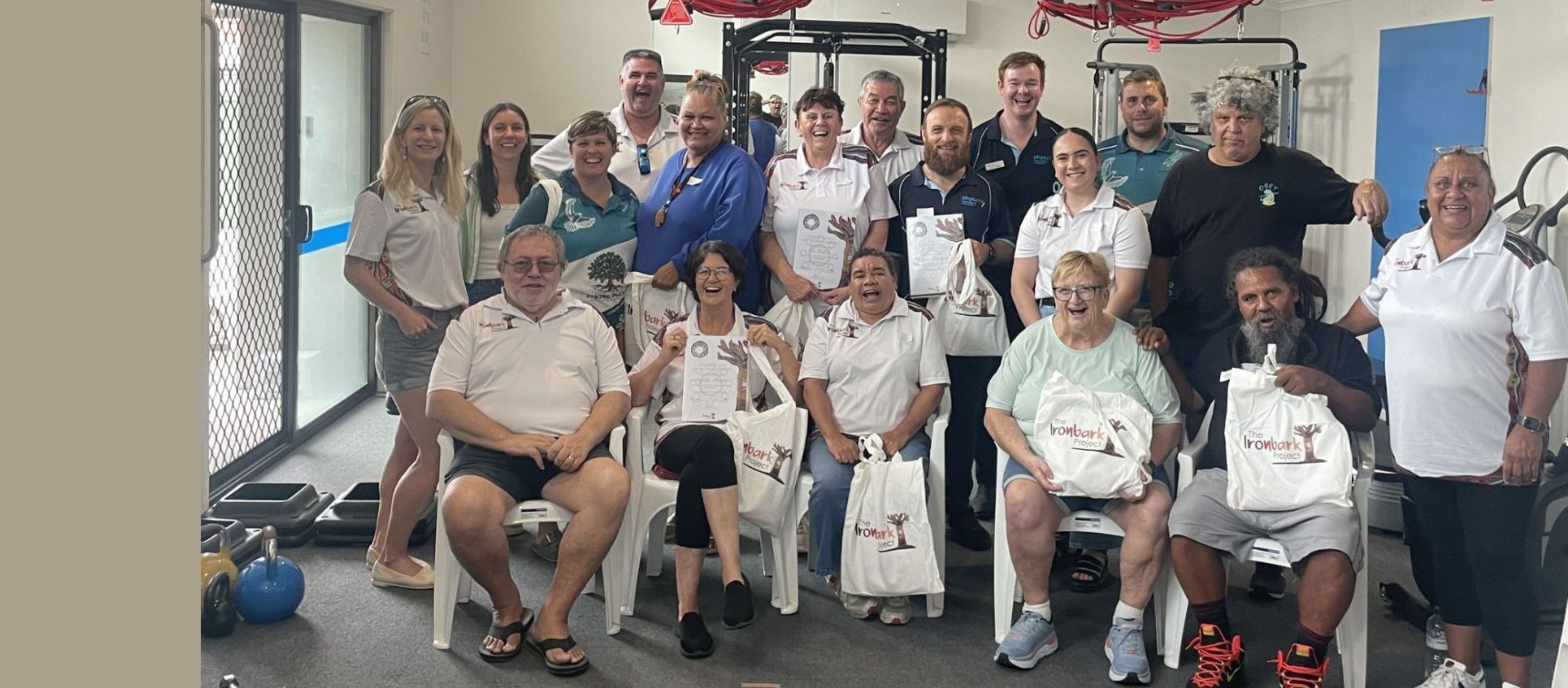
Ironbark Standing Strong and Tall falls prevention program
Background and rationale
- Fall-related injury is an issue for older Aboriginal and Torres Strait Islander people in Australia and worldwide. Culturally relevant programs that increase physical activity and prevent falls are vital. In Australia, the number of older Aboriginal and Torres Strait Islander people is growing, yet few community-led falls prevention programs exist for this community.
- Ironbark is an Aboriginal co-designed and governed fall prevention program that involves weekly group-based balance and strength exercise, yarning sessions, and socialising, which incorporates cultural strengths and Aboriginal ways of knowing, being and doing.
- The Ironbark program was developed in response to feedback from researcher-conducted yarning circles, a cultural way to share knowledge, with older Aboriginal people about the impact of falls held in 2014. Feedback highlighted that an ongoing, Aboriginal-specific, group-based falls prevention program was needed, that could be run through established Aboriginal organisations.1
- The Ironbark program for Aboriginal people aged 45 years and over was designed and initially evaluated with six Aboriginal community organisations in 2015–2016.2
- Physical activity programs that involve Aboriginal people in the planning stages, during and after will ensure better engagement and self-determination for older Aboriginal people.
Outcomes and impact
- The pilot program led to significant improvements in leg strength, balance, gait and a significant decrease in body mass index (BMI) in 77 participants over a 3–6-month period. Importantly, participants reported enjoying the program and stated they would recommend it to others.2
- Following the successful pilot, a controlled pre-post design recruited 21 sites in 2021–2023 for a 12-month period. Sites could choose to receive the Ironbark program or the Healthy Community program (a ‘control’ group that involved yarning sessions and social activities).3,4 Data were collected by Aboriginal research staff, including a process evaluation that examined program fidelity and participant and site staff program experiences.5
- In the 2021–2023 study also found improvements in leg strength, balance, gait and sport and physical activity scores, factors that protect against falls. Yarning revealed that participants enjoyed the program, including the exercises, socialising and education, and felt their confidence and wellbeing improved.6 Site health staff spoke of improved participant motivation, balance, strength and wellbeing.
- Having the flexibility for the program to be tailored to specific communities while remaining effective and evidence based was important. Providing wrap-around support for communities was vital to relationship building and engagement.
- To improve equity and health and wellbeing outcomes, Aboriginal research capacity building is also essential. In Western Australia, Ironbark was implemented into two boodja’s (lands), led by a Noongar Wadjuk Yamatji Ngajdu researcher. Evaluation data from two different Elders groups and stakeholders found they thoroughly enjoyed the program. Additionally, the First Nations people in the South West of Western Australia needed this physical activity program and hope to see it continue.7
- In a discrete choice experiment, participants strongly preferred attending a service over no service and indicated a preference for services that were culturally-specific and incurred lower out-of-pocket participant costs.8
Investment and funding
The Ironbark program has received funding from the National Health and Medical Research Council and NSW Ministry of Health.
Enablers and lessons learned
- Ironbark is an effective community-based program for increasing physical activity, especially balance and strength to prevent falls.
- The program can easily be run by Aboriginal Community Controlled Health Organisations (ACCHO), other Aboriginal organisations, local health districts, and other organisations that support Aboriginal and Torres Strait Islander health.
- Aboriginal community engagement and leadership, sharing of results, and giving feedback are critical to the design, implementation and scale-up of programs addressing health priorities and leading to gains in health and wellbeing for Aboriginal and Torres Strait Islander peoples.
- Program challenges have included ongoing funding sources and transport for participants to be able to attend the program.
Further information
Website, report or contact link: https://www.ironbarkproject.org.au/
References
- Lukaszyk C, Coombes J, Turner NJ, et al. Yarning about fall prevention: community consultation to discuss falls and appropriate approaches to fall prevention with older Aboriginal and Torres Strait Islander people. BMC Public Health. 2017;18(1):77.
- Lukaszyk C, Coombes J, Sherrington C, et al. The Ironbark program: Implementation and impact of a community-based fall prevention pilot program for older Aboriginal and Torres Strait Islander people. Health Promotion Journal of Australia. 2018;29(2):189–98.
- Ivers R, Coombes J, Sherrington C, et al. Healthy ageing among older Aboriginal people: the Ironbark study protocol for a cluster randomised controlled trial. Injury Prevention. 2020;26(6):581–587.
- Macniven R, Simon A, Wilson R, et al. Ironbark: Developing a healthy community program for older Aboriginal people. Health Promot J Austr. 2022;33(Suppl 1):128–33.
- Macniven R, Coombes J, Wilson R, et al. Understanding implementation factors and participant experiences of a cluster randomised controlled trial to prevent falls among older Aboriginal people: a process evaluation protocol. Injury Prevention. 2021:in press.
- Ivers R, Clapham K, Macniven R, et al. Standing strong and tall – Improving mobility and balance in older Aboriginal people through the Ironbark Program. Age and Ageing. Under review.
- Gidgup MJR, Kickett M, Hill KD, et al. Connecting and reconnecting to a community, with a sense of belonging – Exploring Aboriginal Elders' perspectives of engaging in a physical activity program. Health Promot J Austr. 2022;33(Suppl 1):138–49.
- Angell B, Laba T, Lukaszyk C, et al. Participant preferences for an Aboriginal-specific fall prevention program: Measuring the value of culturally-appropriate care. PLOS ONE. 2018;13(8):e0203264.
Photo credit: Strong Spirit Aboriginal Services
Last updated21 October 2026