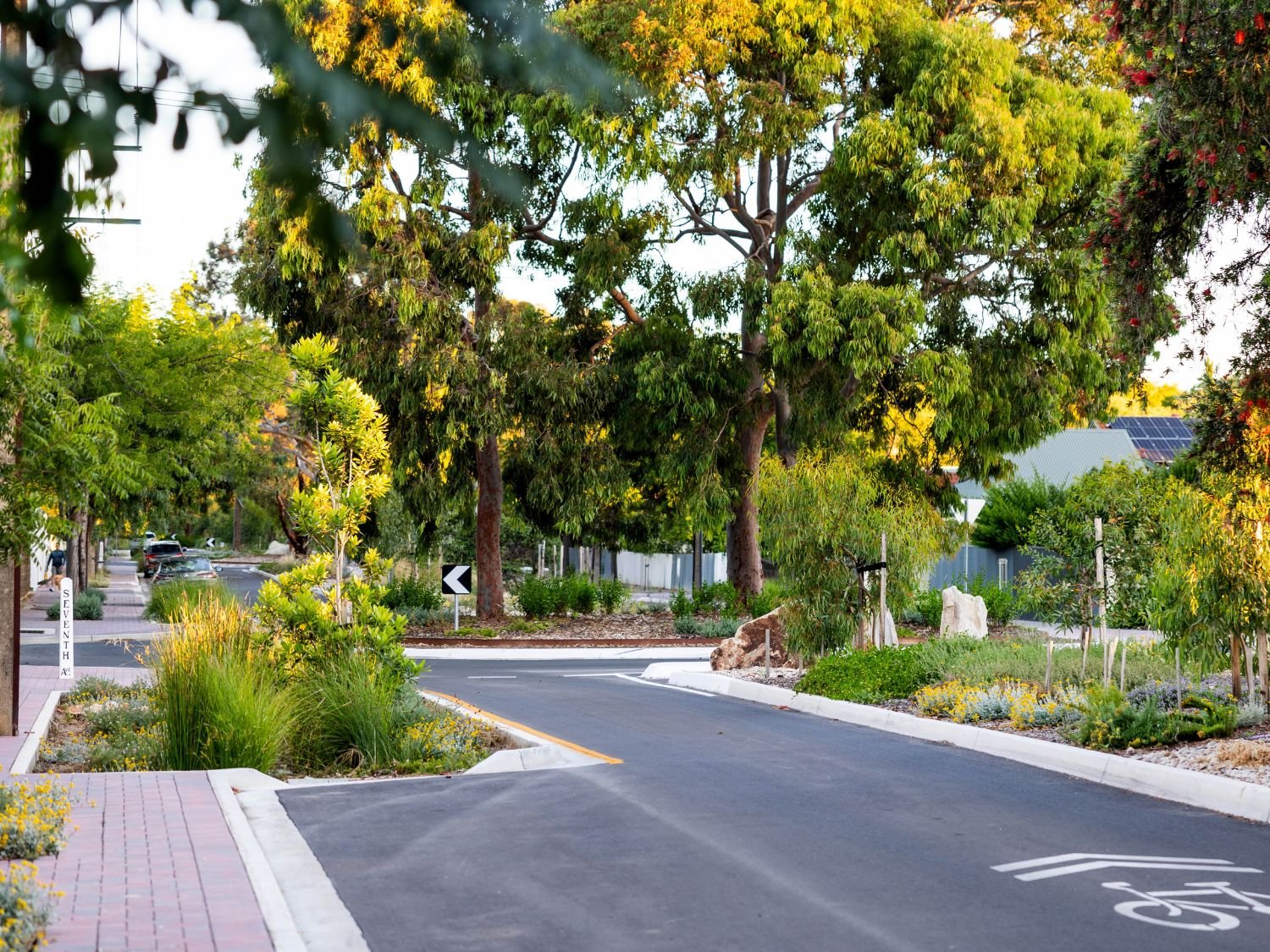
Greening Metropolitan Adelaide
Greening metropolitan Adelaide: a strategy for a cooler, leafier and more liveable city
Background and rationale:
The Urban Greening Strategy for Metropolitan Adelaide aims to protect and enhance Adelaide’s mature trees, green spaces and urban biodiversity. It establishes a shared vision for a cooler, leafier, and more liveable city, underpinned by six priority areas: cooler, greener and healthier development; government leading by example; building nature back in; future-proofing the urban forest; improving greening equity; and scaling up impact by working together.
The strategy was developed in response to growing pressures such as climate change, urban heat, increased infill development, biodiversity loss, and inequitable access to green space. These pressures have contributed to the loss of large trees and tree canopy, increased exposure to heat-related health risks, and a decline in ecosystem services that support liveability. This strategy seeks to address these challenges by embedding nature into the way Adelaide is planned, developed and maintained.
Initiated in 2021, strategy development commenced with a literature review, followed by a practitioner survey (which received 127 responses from 65 organisations), local government workshops (33 participants representing 17 councils) and targeted conversations with key stakeholder groups (including Kaurna, key agency partners, champions and influencers). A discussion paper was produced to inform the next stage of stakeholder engagement, which included a leader's event (60 leaders representing 36 organisations), practitioner summit (70 participants), a scenario planning workshop (40 participants), three technical working groups, sector roundtables (28 leaders representing 22 organisations) and partner conversations. A draft strategy was developed, released for public consultation, refined based on feedback, and formally launched in 2025.
The strategy was developed to guide a coordinated, cross-sector approach to increasing tree canopy, improving biodiversity, and embedding green infrastructure across public and private land. It was led by Green Adelaide on behalf of the South Australian Government, and developed in partnership with state agencies, metropolitan councils, non-government organisations, industry peak bodies, research institutions, Kaurna representatives, community groups and the broader public.
Outcomes and impact:
The strategy is expected to deliver a range of wellbeing and environmental outcomes. These include enhanced community wellbeing through improved air quality, increased physical activity, shade, mental wellbeing and social connection, and a more equitable distribution of the social, environmental and economic benefits of urban greening. Cooler, more climate-resilient neighbourhoods are anticipated through reduced exposure to extreme heat, improving thermal comfort, and mitigation of the urban heat island effect. Biodiversity and ecosystem health are expected to improve through the restoration of native vegetation, enhanced habitat connectivity, and supporting species persistence across the urban landscape.
Measurable targets and indicators have been, and will continue to be, established to track the strategy’s progress towards achieving these impacts and outcomes. It sets a goal of achieving 30% urban tree canopy cover across metropolitan Adelaide by 2055, with canopy cover measured every 4–5 years to monitor progress. Achieving this would represent a significant increase, as current estimates indicate that more than 70% of suburbs have less than 20% canopy cover. This target is supported by two performance investigation areas, reducing urban heat and improving plant species diversity. On average, metropolitan Adelaide is 3.2 °C hotter than comparable undeveloped areas, with significant variation in heat intensity across the region. Additionally, trees along metropolitan Adelaide’s streets and in reserves have been found to represent a limited number of species. As measurement technologies and analytical methods for urban heat and species diversity continue to evolve, specific techniques and targets will be developed in collaboration with key partners in the future.
Investment and funding
Green Adelaide leads a collaborative, annual process to identify priorities for shared action and co-investment with councils to support strategy implementation. Investment decisions are guided by principles that prioritise initiatives aligned with the strategy’s vision, address known gaps, scale up what works, harness cross-sector collaboration, and deliver community, environmental, economic and efficiency benefits. Implementation will be supported through three main funding mechanisms, co-investment by partners; mobilisation of new funding opportunities; and use of existing grant programs.
Enablers and lessons learned
Key enablers of the strategy’s development include its coordinated, strategic approach, highly participatory development process, alignment with existing governance, policy and planning frameworks, and use of established partnerships and programs. Its strategic, coordinated approach helped align efforts across sectors, while strong stakeholder participation built shared ownership, strengthened relationships and created momentum. Alignment with existing governance frameworks supports integration into existing planning systems. Leveraging established partnerships and programs enabled more efficient use of existing resources to support implementation.
Key challenges identified by stakeholders anticipated to affect implementation include the impacts of climate change, and securing adequate water to support healthy, thriving green spaces. Increasing housing density, loss of mature trees, and limited verge space due to competing infrastructure demands also present constraints. A lack of diverse understory and mid-storey vegetation limits habitat quality and climate-resilience. Community awareness and perceptions were additional barriers, highlighting the need for ongoing education and engagement.
Last updated21 October 2026