Daughters & Dads Active & Empowered
Background and rationale
Daughters & Dads Active & Empowered is the world’s first physical activity and wellbeing program targeting girls and their fathers/father-figures. In Australia, 91% of girls1 and 75% of men2 don’t meet physical activity guidelines. Gender prejudice marginalises girls from physical activity and sport with less than 5% mastering fundamental sports skills before high school3. Meanwhile, positive father involvement is strongly associated with improved health outcomes for children; however, globally, only 6% of participants in parenting programs to address childhood obesity are fathers4. Moreover, fathers interact more with their sons than daughters5.
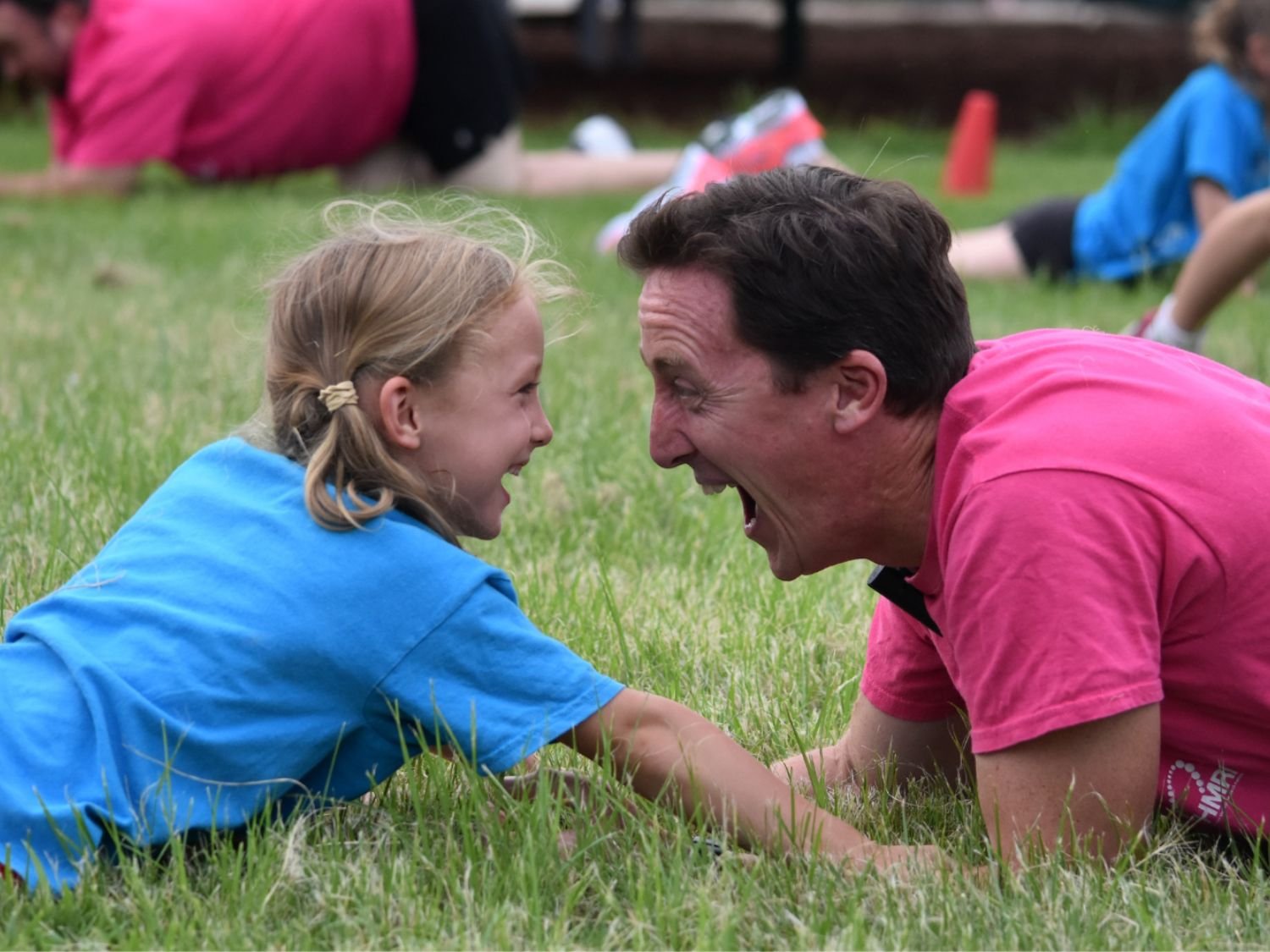
In 2014, researchers from the University of Newcastle developed Daughters and Dads Active and Empowered, a community program harnessing father-daughter relationships to improve family physical activity and health. The program, delivered in schools, sports clubs and community centres, involves a dads-only session equipping father-figures with parenting skills and motivation to improve their daughter’s physical activity levels and mental health. Daughters and dads then attend 8 weekly sessions together involving engaging education on how and why to increase their physical activity as well as understanding and combatting gender prejudice. Participants also engage in rough and tumble play, fundamental movement skill development and fitness. These sessions, alongside an innovative home program, encourage long-term health-behaviour change.
Outcomes and impact
The primary outcome of the program is improving physical activity. Published research has shown that across efficacy, effectiveness and implementation trials the program achieves this outcome6-8. The program also improves girls’ sport skills, screentime behaviours and social-emotional wellbeing, as well as father’s parenting practices, the father-daughter relationship, family6-11. Research has shown benefits for fathers, daughters, and the family unit are maintained 312. To date, 7,200 daughters and dads have experienced these multifaceted benefits.
The program also improves the gender equity practices of fathers in their families and workplaces, whilst facilitator training improves gender equity and teaching practices. Over 700 facilitators continue to make a ripple effect of improved gender equity practices in schools, sports clubs and workplaces.
Delivered across Australia, the UK, Austria, and South Africa, five sport-specific variations (cricket, basketball, football, cycling, golf) have also been developed in partnership with peak sporting bodies.
Investment and funding
The program has received $4.6 million in research funding and over $400 thousand in commercial funding. Key funding partners include:
- Hunter Children’s Research Foundation/Port Waratah Coal Services – research trials
- NSW Office of Sport – Her Sport, Her Way scale-up across NSW and development of sport-specific variations
- Sport England – scale-up across the UK
- Cricket Australia, Football NSW/Northern NSW Football, Golf Australia, WestCycle – program delivery
Enablers and lessons learned
Strong partnerships with sporting, government, education, and community organisations have created valuable two-way benefits. A shared commitment to collaboration and continuous improvement has expanded the program’s reach and impact. Partners gain improved reputation and stronger community connections, while reinforcing their dedication to gender equity and holistic health. The program’s messages also influence their organisational culture.
A major driver of success is the direct approach to addressing gender-based barriers to physical activity. By developing girls’ sporting skills, critical thinking, emotional wellbeing, and strengthening father or father-figure involvement, the program empowers girls to lead active, confident lives.
Daughters & Dads Active & Empowered has received over 20 national and international awards and was highlighted by the World Health Organization as a leading, effective initiative in physical activity promotion.
To learn more or become part of the program’s ongoing success, contact the University of Newcastle.
Further information
References
- Guthold R, Stevens GA, Riley LM, Bull FC. Global trends in insufficient physical activity among adolescents: a pooled analysis of 298 population-based surveys with 1· 6 million participants. The lancet child & adolescent health 2020; 4(1): 23-35.
- AIHW. Physical activity: AIHW, Australian Government, 2024.
- Eather N, Bull A, Young MD, Barnes AT, Pollock ER, Morgan PJ. Fundamental movement skills: Where do girls fall short? A novel investigation of object-control skill execution in primary-school aged girls. Preventive medicine reports 2018; 11: 191-5.
- Morgan PJ, Young MD, Lloyd AB, et al. Involvement of fathers in pediatric obesity treatment and prevention trials: a systematic review. Pediatrics 2017; 139(2): e20162635.
- McClintock EA, Shafer EF. Sex of Child, the Fatherhood Bonus, and Fathers' Work Hours. Journal of Marriage and Family 2025; 87(5): 2178-88.
- Morgan PJ, Young MD, Barnes AT, Eather N, Pollock ER, Lubans DR. Engaging fathers to increase physical activity in girls: the “dads and daughters exercising and empowered”(DADEE) randomized controlled trial. Annals of Behavioral Medicine 2019; 53(1): 39-52.
- Morgan PJ, Rayward AT, Young MD, et al. Establishing effectiveness of a community-based, physical activity program for fathers and daughters: a randomized controlled trial. Annals of Behavioral Medicine 2022; 56(7): 698-711.
- Ashton LM, Rayward AT, Pollock ER, et al. Twelve-month outcomes of a community-based, father-daughter physical activity program delivered by trained facilitators. International Journal of Behavioral Nutrition and Physical Activity 2024; 21(1): 101.
- Pollock ER, Young MD, Lubans DR, et al. Impact of a father–daughter physical activity intervention: An exploration of fathers’ experiences. Journal of Child and Family Studies 2020; 29(12): 3609-20.
- Pollock ER, Young MD, Lubans DR, Eather N, Morgan PJ. Effects of a father–daughter physical activity intervention delivered by trained facilitators in the community setting on girls’ social-emotional well-being: A randomized controlled trial. Developmental Psychology 2023; 59(10): 1852.
- Young MD, Lubans DR, Barnes AT, Eather N, Pollock ER, Morgan PJ. Impact of a father–daughter physical activity program on girls’ social–emotional well-being: A randomized controlled trial. Journal of Consulting and Clinical Psychology 2019; 87(3): 294.
- Morgan PJ, Grounds JA, O’Connor R, Lee DR, Ashton LM. Long-term outcomes of a father-daughter program for sport participation, activity, wellbeing, and gender equity: a 3-8-year mixed-methods follow-up. BMC Public Health 2026.
Last updated21 October 2026